
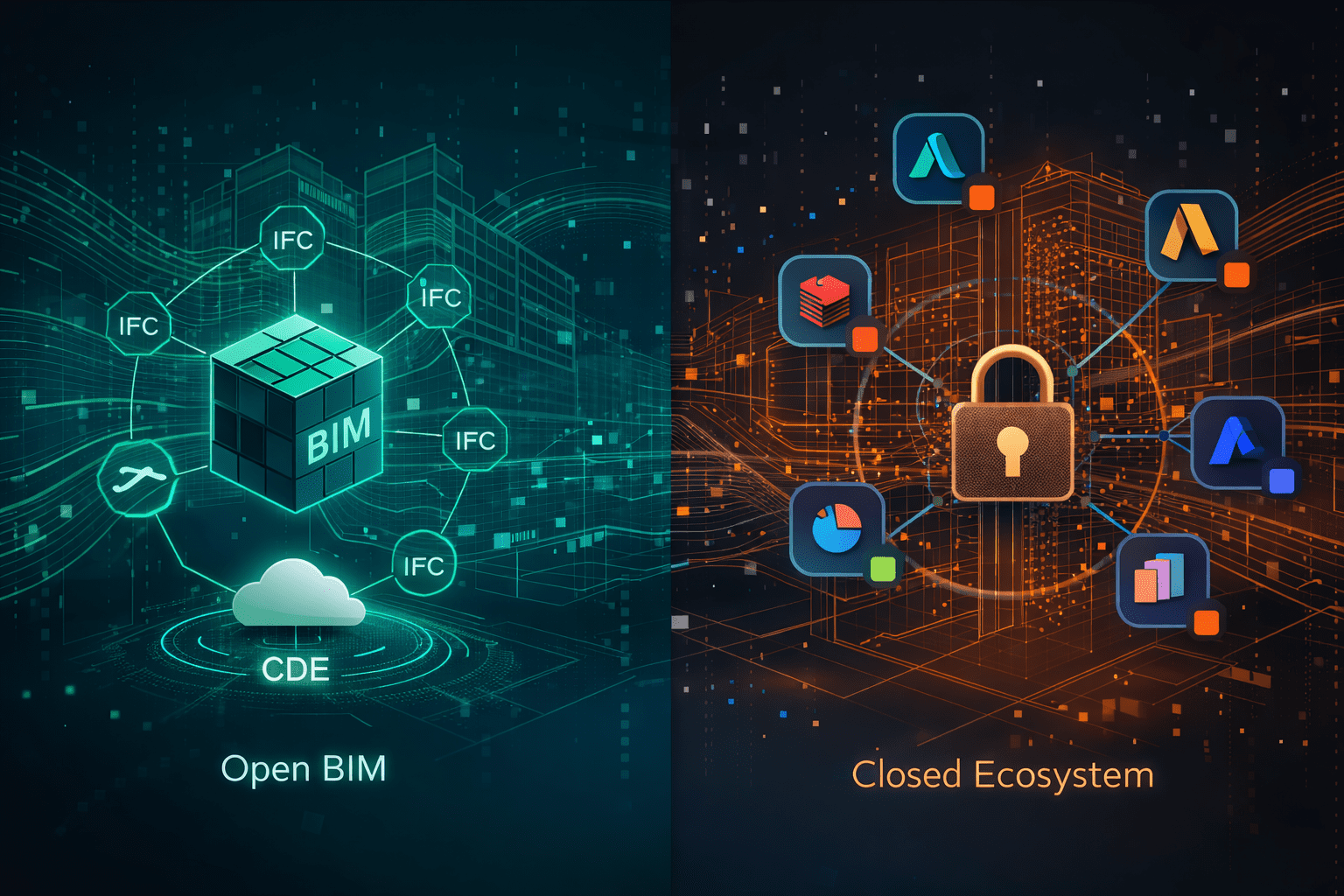
As a client, you are not making decisions about software icons; you are making decisions about data. The real question is: in 5–10 years, who will own and how will you access the project information? Will it be accessible in a vendor-neutral way, integratable with other systems (FM/CAFM/CMMS/BMS), and will it be entirely auditable within a standardized process?
The answer is most often Open BIM: an approach based on open standards (e.g., IFC, BCF), featuring a controlled information flow within a CDE (Common Data Environment), and governed by a role and approval system based on the EIR and BEP. This framework ensures that decisions and quality assurance remain transparent, traceable, and searchable.
A cikk tartalma
What is BIM?
BIM is not just “pretty 3D”; it is an integrated information process where every model element (walls, MEP, equipment) carries data: material, manufacturer, installation date, maintenance cycle, warranty, etc. A well-structured model can be queried and tracked years later—it is the “digital twin” of the facility.
The engine of this operation is the CDE (Common Data Environment), the “single source of truth,” which stores documents, models, and communications with version control and strict permission management—following ISO 19650 processes.
Open BIM vs. Closed Ecosystems: What Are You Actually Deciding On?
- Open BIM: Based on open data exchange (IFC, BCF), allowing the team to choose the right tool for the job. The open schema ensures seamless collaboration even in mixed software environments. The advantages of Open BIM include flexibility, scalability, and long-term cost-effectiveness.
- Closed Ecosystem: Organized around a single vendor’s product suite. It often seems simpler at the outset, but the risk of future switching costs, vendor lock-in, and limited interoperability increases significantly over time.
IFC and DWFx: Serving Different Purposes
DWFx is primarily a format used for visualization and review purposes. It is easy to export from Revit, for example, and is useful for viewing models or performing basic coordination tasks. However, the format essentially contains only geometry and display information (e.g., textures) and does not provide a comprehensive, structured transfer of BIM data. For this reason, it cannot be considered an open, lifecycle-spanning data exchange format.
IFC, on the other hand, is a vendor-neutral, open standard (ISO 16739) developed specifically for the interoperable exchange of BIM data. The IFC 2×3 Coordination View 2.0 is still widely used in the industry today, enabling the coordinated use of disciplinary models and the transfer of information across different software environments.
“Base Quantities” and Proxy Objects
For accurate quantity takeoffs (5D BIM), it is absolutely essential that Base Quantities or appropriate Property Sets are transferred during IFC export. If a native model object lacks a corresponding IFC entity, the element is exported as an IfcBuildingElementProxy object—meaning the geometry appears, but the structured data does not. The number of such elements should be strictly minimized through modeling rules and project requirements, as they significantly degrade the accuracy of automated quantity takeoffs and data processing.
6 Decision-Making Criteria for Clients
1. Data Ownership and Accessibility in 5–10 Years With open deliverables (IFC + mandatory fields/Property Sets, Base Quantities), the handed-over information remains vendor-neutral. You should stipulate the required IFC version, MVD (Model View Definition), and the principle of transferring Base Quantities/parameters within your contracts.
2. Collaboration with Multiple Stakeholders Disciplinary models (architectural, structural, MEP) are combined in a federated view, and can be jointly accessed and reviewed in the CDE. A 4D environment links the project schedule to the model (e.g., MS Project/Primavera), visually supporting the construction logic.
3. Quality Assurance and Auditability Clash detection is not the same as 4D scheduling, but it is closely related. During model-based coordination, linking 3D models with the schedule allows for the identification of time-based clashes—conflicts that only appear during a specific construction phase. Certain coordination software (such as Navisworks’ Timeliner and Clash Detective modules) directly supports this. Clash detection results are shared and tracked as reports within the CDE, ensuring transparent fault management and auditability.
The BIM Execution Plan (BEP) documents the clash detection matrix and the system of applied tolerances. These usually become stricter as the project progresses—for instance, working with a larger tolerance (e.g., 200 mm) in the conceptual phase, but enforcing much smaller values (e.g., 5 mm) during the construction design phase.
4. Integration with FM/CAFM/CMMS/BMS (7D) During facility management, the targeted, structured handover of data (maintenance cycles, warranties, asset-level identification) is what truly delivers value. A 7D model brings cost reduction and transparency; it is good practice to apply COBie and open formats (e.g., CSV/XML).
5. Costs: Licensing + Switching Costs + Vendor Lock-In Because of the flexibility of Open BIM, the market is more competitive, and excessive vendor lock-in is avoided. BIM-supported design and coordination improve ROI through error reduction and the optimization of materials and labor.
6. Supplier Market and Resource Availability Supporting open standards and mixed toolchains makes it much easier to assemble project teams, even for complex Revit–Archicad–MEP combinations.
When Might a Closed System Be Justified?
- For fast pilot projects and homogeneous teams in the short term.
- To minimize the burden of training and culture change at the launch of a project. (Note: Many challenges—such as data management and training—will inevitably surface on the BPM/IT side anyway).
Even in these cases, it is highly recommended to request open deliverables (IFC + key fields) so the project retains long-term flexibility.
When Does Open BIM Provide an Advantage?
- Complex Portfolios and Operations: With 7D data and integration, you enable proactive maintenance and vastly better energy and resource management.
- Multiple Tenders/Partners: Operating in a mixed software environment with federated models makes switching vendors and contractors much easier.
- Risk Reduction: Early filtering of clashes mitigates time and cost risks (advanced clash detection can result in cost savings of 20–30%).
Practical Checklist for Clients
- ISO 19650-Compliant Operation: CDE, roles, approvals, and data drops must all be clearly recorded in the EIR and BEP.
- Compiling the EIR/BEP: Define targeted uses (4D/5D/FM), mandatory fields, and agreed LOD/LOI (Level of Development/Level of Information) levels per phase.
- IFC Rules in the Contract: Specify MVD, Base Quantities, export of native parameters, and the minimization of proxy objects.
- Clash Management and QA: Establish the clash matrix, tolerances, and logged reports/assignments within the CDE.
- Preparing FM/CAFM Integration: Define 7D data content, handover formats (e.g., COBie, CSV/XML), and necessary APIs.
Frequently Asked Questions
1) How does Open BIM differ from a closed ecosystem?
Open BIM uses open-standard data exchange (IFC, BCF) to enable software-independent collaboration; closed systems rely on native formats tied to a specific vendor.
2) What is IFC, and why are “Base Quantities” important?
IFC (ISO 16739) is the open data model standard. Without enabling Base Quantities, cost estimators cannot access the geometric quantities necessary for accurate calculations.
3) Revit or Archicad—does it matter?
Models can be federated: architectural, structural, and MEP models can be combined (e.g., in Navisworks), while the schedule arrives from MS Project. What matters is the agreed-upon LOD/LOI and the CDE process.
4) Why isn’t a PDF enough?
A PDF is not a machine-readable model. The goal of Open BIM is to have structured, queryable data and strict quality assurance (governed within a CDE/EIR/BEP framework).
5) Where does Open BIM pay off the most?
In multi-stakeholder projects, portfolio management, and 4D/5D environments—where visualized scheduling and clash management filter out errors early.
6) Who writes the EIR/BEP?
It is highly recommended that this is initiated from the client’s side. Effective strategic planning requires the AIR/OIR/PIR/EIR/BEP conceptual framework.
7) What tools are needed?
BIM authoring software (e.g., Revit/Archicad), 4D/5D and clash detection software (e.g., Navisworks), and a dedicated BIM CDE (e.g., Autodesk Construction Cloud / BIM 360, Trimble Connect, ProjectWise).
What is the Next Step?
If your primary goal is to possess a long-term accessible, vendor-neutral data asset seamlessly integrated with your operations, it is worth choosing the Open BIM approach. Utilizing an ISO 19650-based CDE process, rigorous EIR/BEP documents, and IFC-based deliverables establishes the usability of 4D/5D and 7D (FM/CAFM/CMMS) right from the earliest phases of design.
AFMTEC’s Design Support Service accompanies your implementation journey from compiling the EIR/BEP and introducing the CDE, to developing IFC rules and the clash detection matrix—laying the perfect groundwork for future 7D/FM integration.