A cikk tartalma
- Hungary’s First BIM Management System Certification
- The Role of ISO 19650 and BIM Compliance in the Construction Industry
- Strategic Cooperation with Olajterv
- BIM Audit and Gap Analysis: Laying the Foundations
- System Design and Implementation
- Successful International Certification
- A Milestone in the Domestic Construction Industry
- Frequently Asked Questions About BIM Certification
- What does BIM certification mean in practice?
- What is the difference between ISO 19650 and UNI/PdR 74 certification?
- How long does it take to achieve BIM certification?
- Why is a BIM audit important at the beginning of the process?
- What benefits does BIM compliance provide for a company?
- Is BIM certification only relevant for large corporations?
- How does AFMTEC help in obtaining BIM certification?
Hungary’s First BIM Management System Certification
Today, digitalization in the construction industry is no longer just a technological trend; it is a clear prerequisite for competitiveness. Companies aiming to participate in international projects increasingly find that BIM-based operations and standardized information management are not merely an advantage, but an absolute baseline requirement.
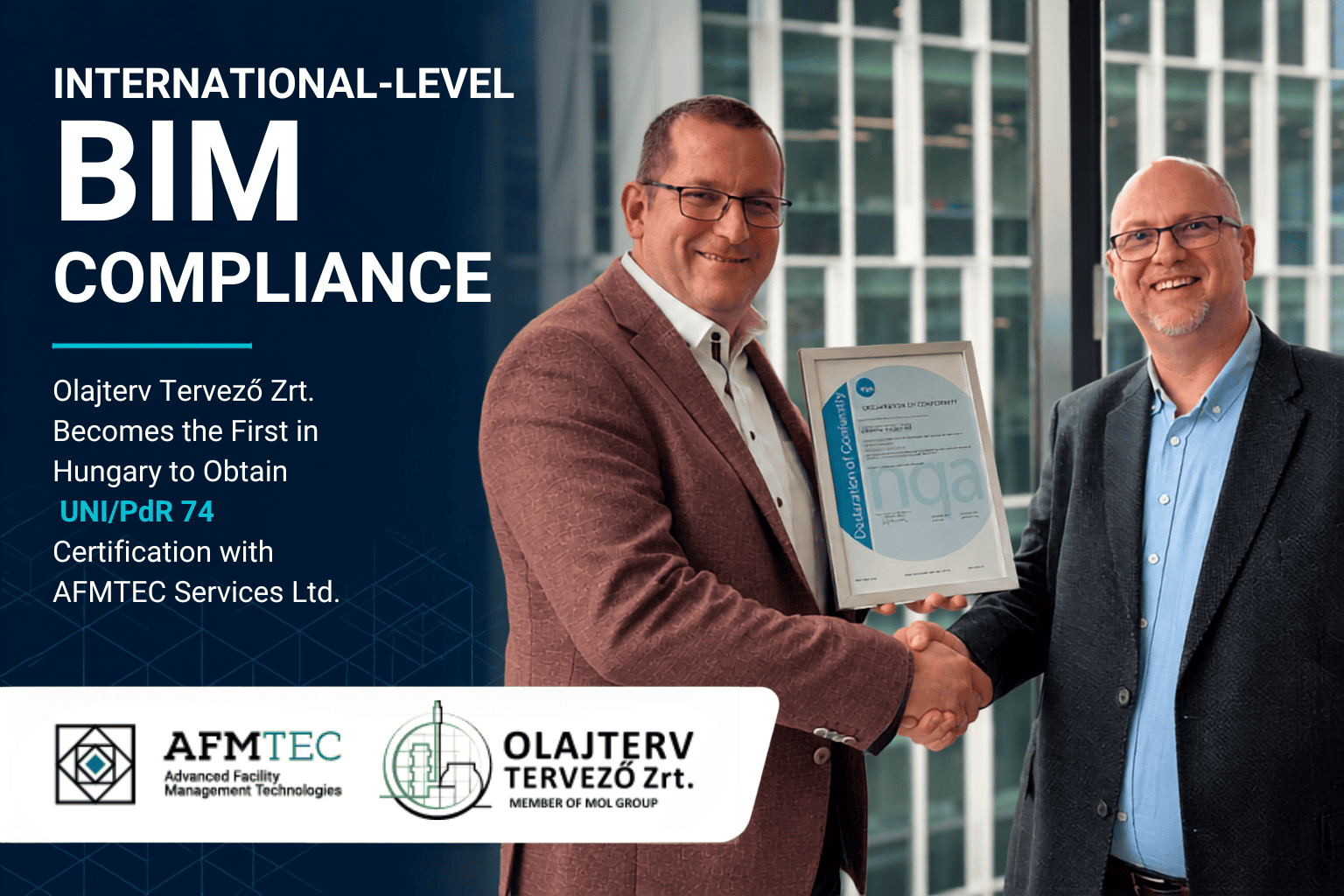
In this environment, Olajterv Tervező Zrt. has achieved an outstanding milestone. With the professional guidance and preparation provided by AFMTEC Services Ltd., they became the first company in Hungary to obtain the BIM management system certification according to the UNI/PdR 74:2019 standard.
This success represents much more than simply acquiring a certificate; it is the result of a complex, organization-wide transformation that ensures the company’s international competitiveness over the long term.
The Role of ISO 19650 and BIM Compliance in the Construction Industry
A key element of construction digitalization is the ISO 19650 series of standards, which defines the international framework for BIM-based information management. The standard aims to establish a unified foundation for managing data generated during projects, ensuring transparency, efficiency, and seamless collaboration among various stakeholders.
The ISO 19650-2 standard specifically applies to information management processes during the project delivery phase. As a so-called “product standard,” it examines compliance at the level of specific projects. In practice, this means that during certification, a selected project is audited, and the evaluation is based on the organization’s performance within that specific project. However, this approach primarily ensures compliance at the project level.
In contrast, the UNI/PdR 74:2019 standard represents a higher tier: a management system-level approach that aligns the company’s entire operation with the requirements of ISO 19650-2. Thus, the certification ensures audited and continuously maintained compliance for the organization as a whole, rather than just for a single project. This distinction is of fundamental importance for entering international markets.
Strategic Cooperation with Olajterv
In July 2025, Olajterv Tervező Zrt. and AFMTEC Services Ltd. launched a strategic partnership to ensure the company’s operations met international BIM expectations.
The goal of this joint effort was not merely to obtain a certificate, but to establish a stable, long-term sustainable operating system that truly complies with international standards and enables participation in international projects.
Under our mandate, Olajterv prepared to obtain the UNI/PdR 74:2019 certification issued by the Italian accredited branch of the NQA international certification body. From the very beginning, this made it clear that we were dealing with a comprehensive organizational development process, not just a simple implementation.
BIM Audit and Gap Analysis: Laying the Foundations
As the first step of our joint work, AFMTEC conducted a comprehensive BIM audit and gap analysis at the company. This phase played a crucial role in providing an accurate picture of current operations and identifying areas for development.
During the process, we conducted interviews with relevant professional staff and company leaders, reviewed existing documentation and workflows, and assessed the widespread understanding of BIM within the organization. Based on the information uncovered, a detailed gap analysis was prepared, clearly highlighting the differences between current operations and the standard’s requirements.
The results were presented to the company’s management, emphasizing the key areas where development was needed. These included standard-compliant template documents, process regulation elements, as well as training and competency development needs. This step ensured that further developments were built on a realistic, highly relevant business foundation.
System Design and Implementation
Following the jointly approved development schedule, the actual professional implementation began.
During this process, we established BIM process regulations for individual disciplines, ensuring unified operations and the consistent handling of information. In addition, we prepared the template documents required by the standard, which became an integral part of daily operations.
Special emphasis was placed on developing organizational knowledge: we held basic and advanced BIM training sessions for employees so that they could not only use the new system but also fully understand how it works.
The most important step, however, was embedding the necessary information management elements into the company’s operations not just in theory, but in practice. As part of this, Olajterv applied the new BIM-based operating model to an actual, live project.
Following the realization of professional compliance, the elaboration of documentation related to the management system and the formalization of the system’s operation took place. The preparation process concluded with a comprehensive internal audit and management review, ensuring that the organization met the standard’s requirements at every single level.
Successful International Certification
The certification audit took place in January 2026. Throughout this process, AFMTEC’s experts guided Olajterv through both the documentation review and the on-site audit.
As a result of the process, Olajterv Tervező Zrt. became the first company in Hungary to obtain the UNI/PdR 74:2019 management system certification, a qualification that is widely recognized and highly respected in international tenders.
This certificate not only verifies the professional compliance of BIM-based operations but also demonstrates the company’s organization-wide readiness for the rigorous requirements of international projects.
A Milestone in the Domestic Construction Industry
Olajterv’s successful certification clearly indicates that BIM-based information management is no longer merely a technological issue; it is a strategic competitiveness factor in both the domestic construction industry and the international market.
This achievement clearly demonstrates that with the right professional support and conscious organizational development, domestic companies are fully capable of meeting the highest international expectations.
We would like to take this opportunity to congratulate CEO Gábor Juhász and the entire Olajterv team for their successful preparation and for obtaining the certification.
Frequently Asked Questions About BIM Certification
What does BIM certification mean in practice?
BIM certification verifies that a company’s operations comply with international BIM standards, particularly the requirements of ISO 19650. This means far more than just utilizing the right software; it entails structured information management, highly regulated processes, and organization-wide digital operation.
What is the difference between ISO 19650 and UNI/PdR 74 certification?
ISO 19650-2 primarily examines compliance at the project level, meaning it evaluates operations within a specific project. UNI/PdR 74:2019, on the other hand, operates at the organizational level: it audits the entire company’s processes, thereby ensuring long-term sustainable, standardized BIM operations across the board.
How long does it take to achieve BIM certification?
The duration of the preparation phase depends heavily on the company’s current BIM maturity. In Olajterv’s case, it was a structured, multi-month process consisting of an audit, process development, training sessions, and practical implementation.
Why is a BIM audit important at the beginning of the process?
A BIM audit helps uncover the exact gaps between current operations and standard requirements. This ensures that further developments are targeted and perfectly aligned with real business needs, guaranteeing that compliance is not just achieved “on paper.”
What benefits does BIM compliance provide for a company?
BIM-based operations improve collaboration, drastically reduce errors, and increase project transparency. Additionally, it enables participation in international projects, where standardized operations are now a baseline expectation.
Is BIM certification only relevant for large corporations?
Not exclusively. While the advantages may be more highly visible in larger organizations, it can provide a serious competitive edge for small and medium-sized enterprises as well, especially if they wish to successfully enter international supply chains.
How does AFMTEC help in obtaining BIM certification?
AFMTEC provides comprehensive, end-to-end support: we conduct the initial BIM audit, perform a detailed gap analysis, design the necessary processes and documentation, hold extensive training sessions, and actively guide the company through the entire certification process.