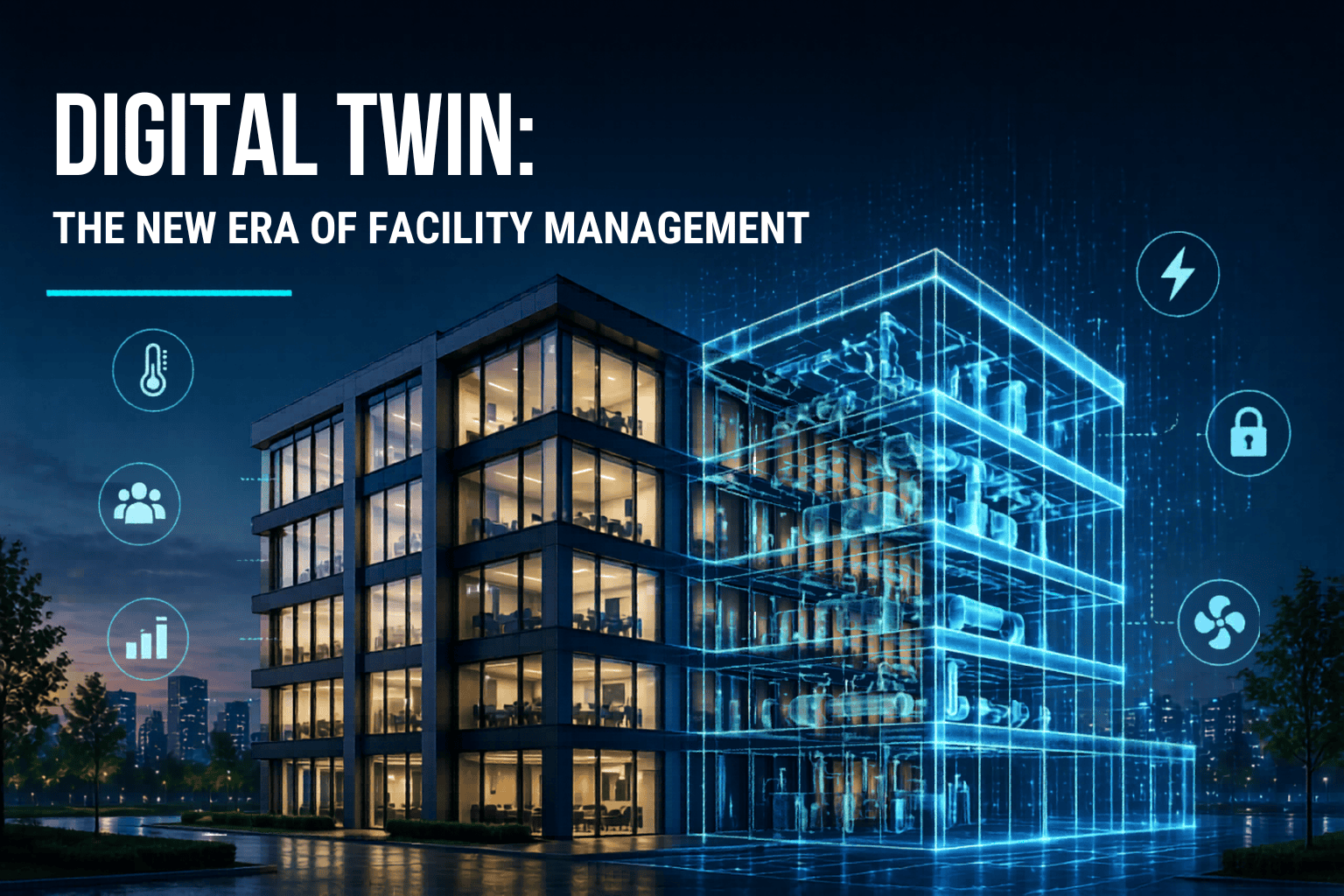
One of the most exciting directions in construction digitalization today is not just BIM, but the digital twin built upon it. While BIM is still primarily thought of by many as a detailed, static digital model, a digital twin means much more: it is a living, continuously updating system capable of showing exactly what is happening in a building using real-time data.
This is not the future. This is the present. An increasing number of buildings are already operating in a data-driven manner today, and the domestic professional discourse is increasingly focusing on how to transform the BIM model into a genuine, functional facility management tool.
This topic is worth examining beyond the theoretical level. In a special DIG-IT x BIMexec episode, domestic experts discussed how BIM and real-time data combine to become true business value in facility management, and what it takes for a digital twin to be a sustainable, functioning system rather than just a spectacular technological showcase.
A cikk tartalma
This article will help you understand:
- What a digital twin is
- How a digital twin goes beyond BIM
- How to build a truly functioning system
- What organizational requirements are necessary to create long-term value
What is a Digital Twin?
Simply put, a digital twin is the digital representation of a physical building, which is not only built once but is continuously fed with data. This data can come from BIM models, sensors, access control systems, Building Management Systems (BMS), or other smart building solutions.
The point is that the digital twin not only shows what the building looks like, but also how it is currently operating. Temperatures, occupancy, energy consumption, faults, system loads, operational patterns—all the information from which better decisions can later be made.
As accurately defined in the podcast: the digital twin is the digital representation of the building that helps you understand what is happening inside it at any given moment. This approach perfectly illustrates that this is not merely about data collection or visualization, but about creating an interpretable, decision-supporting information space.
How is a Digital Twin More Than BIM?
BIM is the foundation. It provides the structured, reliable static data asset upon which further systems can be built. However, the digital twin goes beyond this by establishing a live data connection between the physical building and the digital model.
In other words, while BIM shows how the building was designed and constructed, the digital twin also reveals how it behaves during everyday use. This difference is what makes it truly valuable for facility management.
Based on the expert discussion, a digital twin is built on three pillars:
- The physical reality
- Its digital model
- The data connections that update the model in real time via IoT, sensors, and other integrated systems
This is also where Artificial Intelligence (AI) and analytics come into play: data must not only be displayed but correlated to recognize patterns, ensuring that facility management and maintenance can be genuinely optimized.
How is a Digital Twin Created?
Creating a digital twin is not a matter of installing a single piece of software. Rather, we are talking about a coordinated system where multiple technologies and the work of several stakeholders converge.
On one side is the BIM integrator, who provides the static data, models, documentation, and information structure. On the other side is the Smart Building or IoT integrator, who brings real-time data into the system from sensors, automation systems, and other digital sources.
The digital twin is actually born from the intersection of these two domains. This is what makes it more than just an impressive 3D interface.
The most important takeaway from the podcast was exactly this: neither BIM nor smart building technology alone is enough for a digital twin. A well-functioning system requires the integration of static and dynamic data worlds. BIM provides the structure and informational base, while the smart building ecosystem provides the live data and real-time feedback.
It’s Not Just About Sensors
We often tend to associate digital twins exclusively with sensors, but the reality is far more complex. Data sources for a digital twin can include:
- Temperature and humidity sensors
- Access control systems
- People counting solutions
- Camera systems
- Building Management Systems (BMS)
- Any system from which readable, integrable data can be extracted
This is crucial because a digital twin does not merely “display measured values”; it places them into context. For example, in a specific area, we don’t just know the temperature—we also know how many people are there, the current load on the HVAC system, and how all this impacts operation or security.
What is Needed on the Organizational Side?
Technology alone is insufficient. A digital twin only works long-term if the client possesses the appropriate strategic mindset and organizational background.
First, the goal must be clearly defined. You shouldn’t start building a digital twin just because you saw a nice dashboard or a rotating 3D model; you must start with the specific business or operational problem you want to solve. Do you want to reduce energy consumption? Improve the user experience? Achieve faster fault detection? Enable predictive maintenance?
If this isn’t clarified, the digital twin will quickly become an expensive but barely used technological storefront. The process must start with strategy creation. Without clear goal-setting at the executive level, these systems are hard to implement, harder to maintain, and easily lose their value.
Why Isn’t Technology Enough?
One of the key lessons is that these systems require not only technical but also cultural change. New roles emerge, new forms of collaboration are needed, and the organization must learn to live with the fact that decisions regarding the building’s operation will increasingly be data-driven.
In many places, this means that IT, facility management, automation, and security can no longer operate in isolated silos. A smart building—and especially a digital twin—can only be well-maintained with an integrated mindset. Lack of leadership commitment is the highest risk; without organizational buy-in, even the smartest system becomes a burden rather than a benefit.
Smart Building and Digital Twin: Are They the Same?
No. The two are connected, but not identical.
You can have a smart building without a digital twin. “Smart building” is a broader concept that can encompass various technological and automation solutions. A digital twin, on the other hand, is a specific, integrated information system capable of linking different data sources along a common logic and making them suitable for decision support.
The digital twin becomes exceptionally valuable when it organizes data from the building’s various systems into a single, reliable point of information. This is the “Single Source of Truth” approach. The goal is not for every system to report separately, but to have a shared, interpreted data source upon which operational decisions can confidently rely.
When Should You Start?
As early as possible.
The true power of a digital twin is realized when it appears during the requirements specification phase, even before design begins. It is not enough to “slap” a system onto a building after it is finished. The earlier you decide what data needs to be collected, in what structure, for what purpose, and for what future use, the better the end result will be.
Digital twins can also be created for existing buildings, but the work is typically much harder there, as you have to retroactively assess conditions, fill in missing data, and adapt to legacy systems. For new investments, it is a massive advantage if the BIM and IoT mindset is present from day one.
What is it Good For in Practice?
The biggest advantage of a digital twin is that it enables faster and more accurate decisions. It helps you understand what is happening in the building at any given moment and provides the opportunity to recognize patterns, correlations, and risks from the collected data.
This is particularly crucial in facility management. Such a system can support faster fault detection, fine-tuning of operations, energy optimization, and eventually predictive maintenance—where we no longer just react to faults but attempt to prevent them entirely.
Who Will Use It?
This is one of the most critical questions. A digital twin is worthless on its own if there is no one in the organization who understands, manages, and maintains it.
A key role emerges here: the BIM Application Manager. This position is highly important because this internal professional deeply understands BIM processes, can organize information, develop user logic, and help maintain the order of digital operations for colleagues.
A digital twin only remains valuable long-term if it is not abandoned the moment it is handed over, but rather if its data, processes, and responsibilities are continuously maintained and updated.
What is the Next Step?
The digital twin itself is not the final destination. As more data and higher-quality information become available, the role of analytics, automation, and Artificial Intelligence (AI) becomes increasingly important.
The next massive leap is when the system no longer just shows you what is happening, but also suggests what you should do about it. Which equipment is behaving unusually? Where is a failure expected? Which system is operating wastefully? Where can you intervene before a problem even occurs?
This is the exact point where BIM, IoT, and AI truly converge.
The digital twin is one of the most important next steps in facility management. It does not replace BIM; it carries it forward and brings it to life. It connects real-time data to the static model, providing a level of insight into a building’s operation that was previously unimaginable. Today, the question is no longer whether buildings will have digital twins, but rather who will start building them, when, and with what level of strategic awareness.
Frequently Asked Questions (FAQ)
What is the difference between BIM and a digital twin?
BIM is a static information model, whereas a digital twin is a living system that is continuously updated with real-time data.
Do you need BIM for a digital twin?
Ideally, yes. BIM provides the structured database and informational foundation upon which the digital twin can be built.
How expensive is a digital twin system?
The cost depends heavily on the goals, the depth of integration, existing systems, and whether it is a new or existing building. Poorly defined projects can be expensive and yield a low return on investment.
What are its advantages in facility management?
A digital twin can help with faster fault resolution, reducing energy consumption, predictive maintenance, and highly data-driven decision-making.
Does it only work for new buildings?
No. It can also be created for existing buildings, though the launch is typically more complex because the existing conditions, legacy systems, and available data must first be thoroughly assessed.
What is the biggest mistake during implementation?
Lacking a clear goal. You can live without technology, but without a strategy, the system will never be sustainable.