
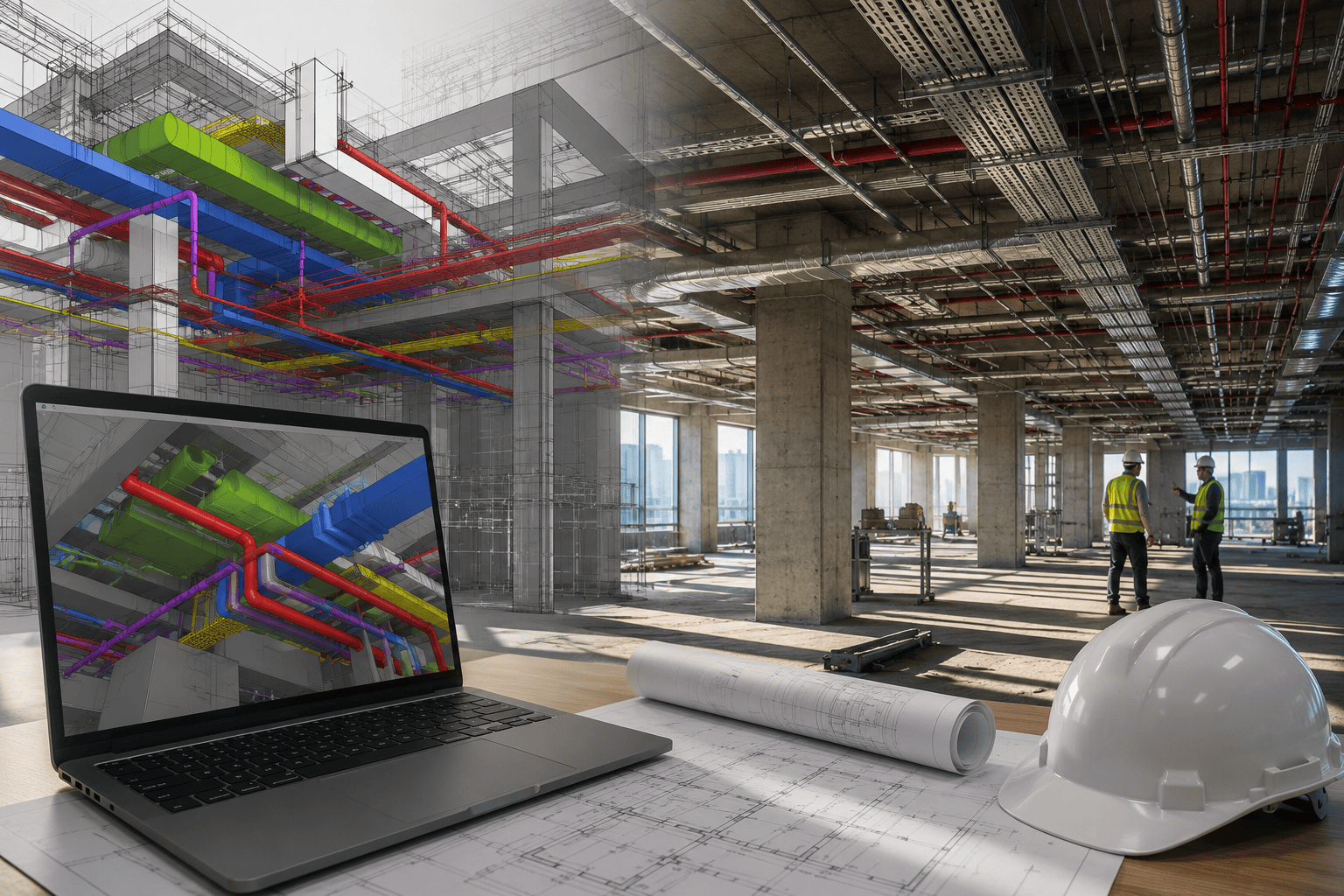
In Hungarian construction practice, the lack of coordination between disciplines—specifically, the failure to synchronise structural, mechanical and electrical designs—often leads to on-site improvisation and a significant need for additional works. When design processes are carried out in isolation and 3D modelling is not BIM-based, critical errors such as ventilation routes intersecting structural elements or missing penetrations remain undetected until the construction phase. Retrospective BIM design audits and multidisciplinary clash detection are used to minimise these systemic risks.
The methodology of a retrospective BIM audit
The essence of the process is the virtual simulation of construction within a unified, intelligent data model before physical works begin. During the assessment, data originating from heterogeneous sources—whether 2D or uncoordinated 3D—are integrated into a common coordinate system.
The assessment is based on two main technical pillars:
Geometric clashes (Hard Clashes): The algorithmic detection of physical spatial overlaps between elements belonging to different disciplines, such as an intersection between a reinforced-concrete structural element and a mechanical service route.
Functional clashes (Soft Clashes): The verification of standard clearance distances, installation spaces and maintenance zones required for the future operation of the building.
Steps in the coordination workflow
A professional audit does not increase the project’s administrative burden. Instead, it relieves project management through the following structured process:
Data integration: The synchronisation of multidisciplinary designs in different formats—such as DWG, PDF and 3D—in a unified coordinate system, followed by model creation.
Software-based clash detection: Algorithmic checking between multidisciplinary models to detect inconsistencies at both geometric and data-content level.
BCF-based issue management: Identified anomalies are recorded in accordance with the international BCF standard, or BIM Collaboration Format. Rather than being documented in difficult-to-manage Excel spreadsheets, issues are tracked through 3D views and tasks assigned to the responsible parties.
Management-level risk analysis: A quantified summary of technical risks to support decision-making by the client or main contractor.
Economic rationale and return on investment (ROI)
The cost and time required to implement modifications during the design phase are negligible compared with the cost of correcting errors discovered during construction. While correcting a service route in the virtual model requires only a brief redesign process, on-site demolition, downtime and delays affecting multiple disciplines can generate additional costs amounting to millions of forints.
Based on practical experience, in the case of a 10,000 m² office project, a retrospective assessment identifies between 50 and 150 critical errors. Preventing only a few of these issues can fully cover the cost of the targeted design audit.
The importance of independent quality assurance
Objectivity is the key to a successful audit. Since neither the designer nor the contractor is entirely free from conflicts of interest when errors are identified, involving an independent integrator—such as AFMTEC Services Kft.—ensures that the client’s interests are properly represented.
In line with the principles of the ISO 19650 standard, the process creates a transparent information ecosystem that improves project predictability and protects the profit margin.